
Large language models (LLMs) are AI systems trained on vast amounts of data to understand and generate human language. Both generative and conversational search are powered by LLMs:
- Generative search: Combines search capabilities and gen AI advances to provide direct, curated responses and recommendations to a user query. A form of search that generates a natural-language response (e.g. Google AI Overviews).
- Conversational search: Advanced search method that uses natural language processing to understand search queries and provide relevant results. Allows back-and-forth dialog between the user and the LLM-based tool (e.g. ChatGPT, Google AI Mode).
LLMs don’t search the web in real time (unless they use retrieval methods). Responses are based on patterns in their training data, which comprises billions of words from sources such as websites, books, Wikipedia, Reddit and more.
LLMs favor content that is:
- Clear and easy to understand
- Well-structured and logically organized
- Fact-based
- Published or associated with trusted sources
The goal is to be seen as a reliable part of the internet’s knowledge base. Your content needs to meet the above standards and exist in places LLMs train on.
In this post we will explore how LLM optimization works, why it matters for ecommerce stores, and concrete strategies you can use to get your brand into AI-generated answers before your competitors.
How LLMs affect search results
Large language models induce direct answers to satisfy user intent, reducing the need to click through multiple links (which might potentially lower traffic to traditional websites). Users ask questions and get complete answers without leaving the AI experience or search engine result page. LLMs are changing search from keyword-based to natural language questions. Dependence on exact keyword matches is reduced in favor of content that answers questions clearly and directly.
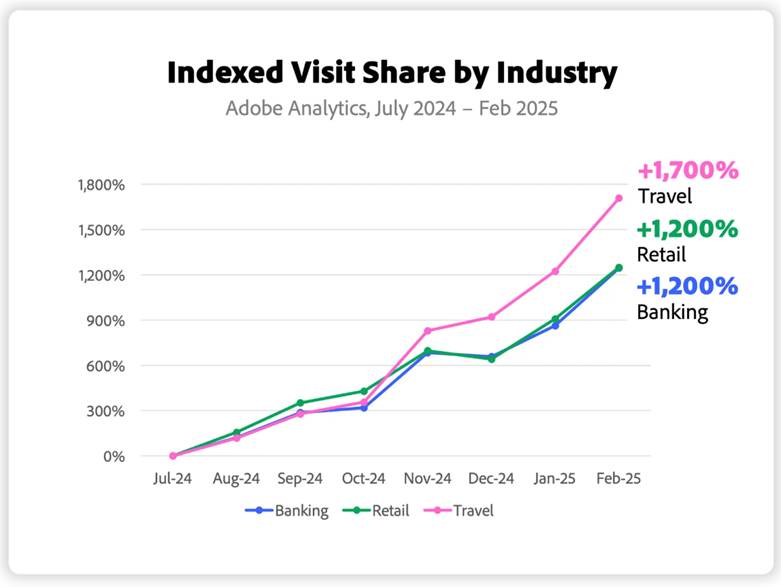
The Adobe research highlights this shift. Between Nov. 1 and Dec. 31 2024, traffic from generative AI sources to U.S. retail sites increased by 1,300% compared to the previous year. The trend has persisted beyond the holiday season. In February 2025, traffic from generative AI sources increased by 1,200% compared to July 2024.
Why you should include LLMO in your SEO strategy
LLM optimization matters because it allows you to improve your brand’s visibility and portrayal in LLM-generated responses – content that people increasingly see and engage with. This way you increase your chances of being cited in AI answers and enhance your content clarity, authority, and snippet potential across search platforms.
The user bases of major AI platforms like Gemini and ChatGPT are also expanding rapidly. In March 2025, Gemini had over 350 million monthly active users and ChatGPT had over 600 million monthly active users.
LLMO can ultimately help you to:
- Increase brand awareness
- Protect and improve your brand’s reputation
- Generate more revenue
AI adoption is set to increase and information about your brand can become embedded in the training data used for future and new versions of LLMs.
Failure to optimize for LLMs can expose your business to many risks, including:
- Considerable traffic drops
- Loss of organic visibility
- Brand dilution (reputation and authority)
What is LLM Optimization?
Large language model optimization is the practice of optimizing your content, webstore, and brand presence to appear in AI-generated responses from tools like ChatGPT, Gemini, Perplexity, Claude, Google’s AI Overviews and Google’s AI Mode. Note that LLM optimization is targeting visibility across any LLM platform, not just Google’s.
Traditional search engine optimization (SEO) focuses on ranking in search results, while the purpose of LLM Optimization is to get your brand mentioned, cited, and recommended within conversational AI responses. Improving brand awareness, trust, and authority throughout the buyer’s journey is in focus, even if users don’t click through to your webstore. It involves building brand authority through mentions on high-authority sites, creating deep content and writing content with information gain.
How frequently do users see LLM responses?
According to Semrush’s AI Overviews Study users in the U.S. saw LLM responses on 13.14% of search results pages in March 2025 and it’s a solid increase from 6.49% in January 2025.
At the same time, many users seek out LLM-generated responses by engaging with conversational AI tools like ChatGPT or Claude which collectively attracted over 600 million unique visitors in May 2025.
With further AI adoption and investment, user exposure to LLM-generated responses is set to grow in 2026.
Why LLM Optimization matters for ecommerce stores
LLM optimization is becoming critical for ecommerce because buying journeys are changing. Customers are no longer relying only on traditional search results to discover products, compare platforms, or choose vendors. Increasingly, they are asking AI-powered tools direct questions like “What is the best ecommerce platform for B2B?”, “Which ERP-integrated webstore should I use?”, or “What is the difference between Shopify and WebSell ecommerce?”
When large language models answer these questions, they do not simply list links. They summarize, recommend, and frame options. If your brand is not present in those AI-generated answers, you may never even enter the customer’s consideration set.
For ecommerce stores, this has several major implications.
First, LLMs influence purchase decisions earlier in the buying journey. AI tools are often used before a customer visits any website. Being mentioned positively in an AI response builds trust and authority before the first click ever happens.
Second, LLMs reduce reliance on traditional click-based traffic. Even if users do not click through immediately, your brand can still gain visibility, credibility, and recall. This is especially important for complex or high-value ecommerce solutions where buyers research extensively before converting.
Third, LLM optimization helps protect brand accuracy and reputation. Without optimization, AI systems may describe your products incorrectly, omit key differentiators, or favor competitors simply because their content is clearer, better structured, or more widely cited. Optimized content improves the chances that your brand is represented accurately and consistently.
Finally, LLM optimization compounds over time. As AI systems continue to evolve, content that is clear, authoritative, and well distributed across trusted sources becomes embedded in future model training and retrieval systems. Early optimization gives ecommerce brands a long-term advantage, especially as AI-driven discovery and agent-led commerce continue to grow.
For ecommerce businesses, LLM optimization is no longer optional. It is a natural extension of SEO that ensures your brand remains visible, trusted, and competitive in an AI-first search environment.
How to do LLM Optimization – 6 practical strategies
There is a lot you can do to optimize for LLM. Below we have outlined 6 practical strategies you can implement to optimize your webstore for LLM’s.
1. Create authoritative content
LLMs look for reliable content, which means it’s well-cited, comprehensive, and written by people (or brand) with expertise. If you are familiar with SEO you should know this from E-E-A-T: experience, expertise, authority and trust.
In Search Quality Evaluator Guidelines, Google explains the E-E-A-T as:
- The first-hand experience of the creator
- The expertise of the creator
- The authoritativeness of the creator, the main content itself and the website
- And trust: the extent to which the page is accurate, honest, safe and reliable
Let’s brake it down:
Experience – the content creator is expected to have necessary first-hand or life experience for the topic. For example, a product review from someone who has personally used the product.
Expertise – show your audience what you know by creating expert-level content. If you are creating content about something not entirely in your wheelhouse, do plenty of research and back up your work with highly credible sources. You audience should see you as a trusted expert in the field and rely on you, your product or service.
Authoritativeness – you establish authoritativeness when your work gets mentioned within your field or niche, other experts are linking to your content, related websites with established authority in your industry are promoting your content. The more backlinks from reputable sources the better.
Trustworthiness – quality and up to date content but not only. Make sure to state the physical location (store address), have Terms and Conditions page accessible for users, ensure security of your webstore domain (HTTPS implementation is a must), cite all sources and link to authoritative websites.
The bottom line of it is that you should back you claims with relevant, recent stats, link to reputable sources and build depth into your content.
2. Get brand mentions on commonly cited websites
Identify sites or pages in your niche that LLMs commonly cite and afterwards work to get your brand mentioned on them.
According to Semrush’s AI search study Quora and Reddit are the most commonly cited websites in Google AI Overviews. You can find niche questions being asked and responded by users, that aren’t addressed elsewhere. That makes it’s a rich information source for specific AI prompts. Worth to mention is that back in 2024 Google made arrangement with Reddit to use its answers as training data for Google LLMs.
Reddit and Quora might be a good place to start but you can think of other branded forums as well. Getting featured on other relevant, high-authority websites could also boost your AI search visibility.
You should start with your own research to identify most commonly cited webpages for your analyzed prompts and keep record of them.
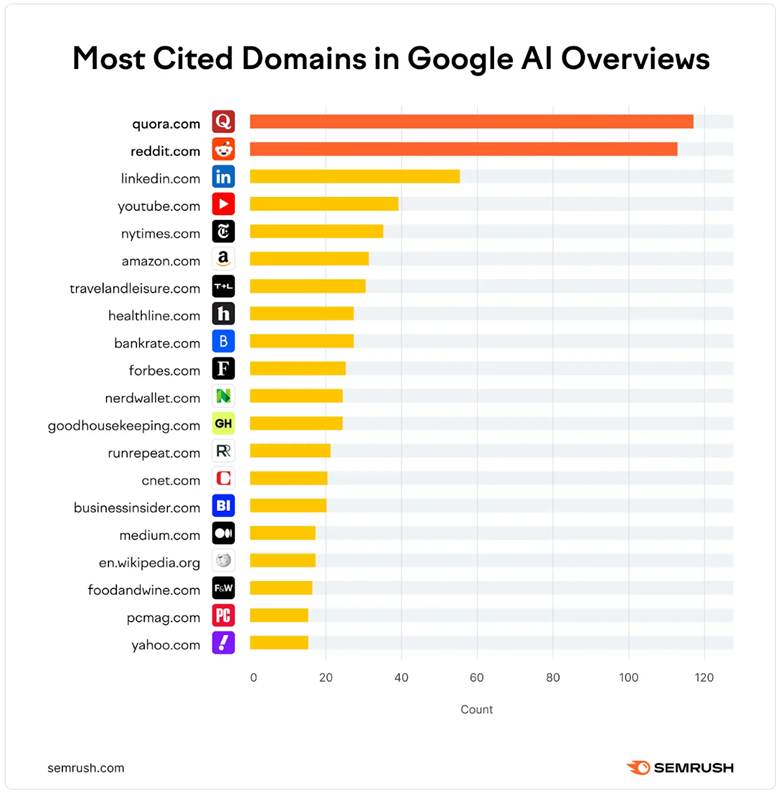
You might want to engage with these platforms and mention your brand where appropriate.
Here’s some ideas that could get you cited:
- guest post on publications that already cite your competitors
- participate in expert roundups where your insights add genuine value
- comment thoughtfully on high-authority industry content with detailed expertise
Keep in mind that citations don’t require links (thoughtful Reddit comments can carry citation weight without clickable links back to your site). When journalists, bloggers or industry experts mention your brand name in articles, LLMs can still associate your business with those topics. Secondly, content depth beats ranking position (detailed post ranking on page 5 can become most-cited asset).
But it’s not all you can do to get mentions from credible sources. There are other ways which include Digital PR (pitch stories or data insights to journalists) and publishing statistics or case studies that others naturally cite. Great platforms for building mentions include:
- industry publications – sources that are popular for your industry
- news outlets
- online forums (Reddit and Quora)
- academic and research sites (Harvard Business Review, Pew Research Center)
- government websites
Don’t chase all possible places, instead focus on:
- pages already being cited by LLMs in your industry/category
- reviews or guides that evaluate your product category
- articles where branded mentions reinforce entity associations.
One more tactic is to become a go-to expert for journalists and content creators in your space by responding to HARO requests (Help a Reporter Out) or sharing unique data or insights that others want to reference.
Remember that brands gain the most visibility by appearing in sources LLMs already trust. To identify those sources make sure to apply consistent tracking. Once you discover new sources, where you brand is not mentioned put in place tactics to get mentions.
3. Use entities
An entity is a person, object, place, brand or concept which can be understood by search engines and LLMs. Entities rely on contextual relationships to help search algorithms understand the intent behind a search query.
Entity optimization is the process of improving how search engines and LLMs recognize and connect entities. In the context of your business, using entities would mean using your brand name and related terms across online channels so they can be picked and analyzed by LLMs.
Remember to aim for descriptive entity references like:
- company name
- locations and people associated with your company
- product lines under your brand
You might want to think about it as building your brand’s ‘identity card’ for LLMs.
In order to strengthen entity visibility make sure to use consistent brand information and NAP (Name, Address, Phone) citations. Consistency improve how LLMs identify you brand and enhance likelihood of being recommended.
Make sure to connect to established, recognizable entities – authoritative platforms that LLMs recognize and trust.
You can start with:
- Wikipedia – if your brand is notable enough to be listed make sure to create or update your entry
- LinkedIn – work on complete company and personal profiles with detailed descriptions
- Crunchbase – list you company and include information about your brand and team including logo, founded date, description, industries and social media links
- Industry directories – make sure to list your business in relevant trade association directories and industry databases
You should aim for your brand to appear consistently across platforms being referenced commonly by LLMs. It’s more likely to be mentioned by LLMs when you brand information appears across multiple authoritative sources.
Here are some other ways you can build mentions of your brand across the web:
- Podcast appearances – get featured on podcasts relevant to your industry
- Press coverage – seek mentions in articles relevant to your industry
- User-generated content platforms (social media) – contribute to industry discussions, but remember not to over-promote your brand, on platforms like Reddit, Quora, LinkedIn
- Industry roundups and ‘best of’ lists – work to get included in list-style articles as those are frequently referenced by LLMs
- Research collaborations – get your brand mentioned as a contributor or data source along with other brands on industry studies
Leveraging entities is essential for effective LLM optimization because entities provide clear, unambiguous signals that help language models understand what a brand, product, or person is and how it relates to a broader category. LLMs learn by recognizing patterns across vast amounts of text, so well-defined entities – supported by consistent naming and authoritative external reference – strengthen those patterns.
When an entity is described clearly and repeatedly across trusted sources, an LLM can form more accurate associations and is more likely to surface that entity in relevant responses.
Entities also reduce semantic noise, making it easier for models to categorize the subject and link it to appropriate contexts, such as industry, function or expertise.
You should remember that while it doesn’t guarantee visibility, strong entity definition increases the chance that an LLM recognizes, understands and meaningfully includes your brand in its output.
4. Understand the Google Knowledge Graph
LLMs often use Google’s Knowledge Graph and other public knowledge bases like Wikipedia to verify entities. If your brand appears in them, you have better chances of getting a citation in generative answers.
The Knowledge Graph is a semantic network that acts as a large, interconnected database of real-world entities, facts and their relationships. It powers features like knowledge panels, answer boxes and autocomplete suggestions to provide users with direct, factual answers to their queries instead of just a list of links. Google uses Knowledge Graph to find and serve information relevant to a query in a Knowledge Panel next to the search results.
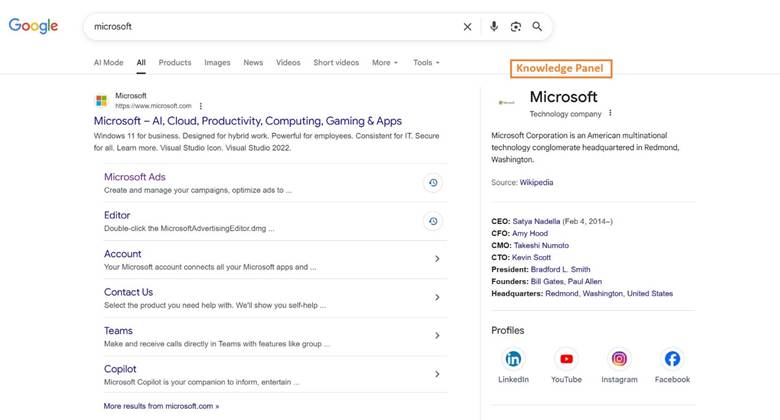
The Knowledge Panel is a type of rich result that appears on the right side of the search engine result page when people search for an entity, such as a person, place, organization or thing. It provides a summary of information about the entity based on Google’s understanding of the topic – it can include facts, images, links and other relevant details.
Here is what a Knowledge Panel looks like:
Knowledge Panels are important for SEO because they can help you:
- Increase your visibility and authority on Google – they can attract more attention and clicks from users, what’s more it shows that Google recognizes your entity as relevant and trustworthy for the query
- Enhance your brand image and reputation – Knowledge Panels can showcase your logo, social media profiles, website and other information that can help users learn more about your business
- Drive more traffic and conversions to your website – direct links to your website, products, services, events, rich snippets (FAQ, how-to guides, videos and images) can be included in Knowledge Panel
You can not directly apply for a Knowledge Panel but there are some things to make it more likely for one to appear, including:
- Pick a primary entity home page – SEO recommendation is to have entity home page on a dedicated ‘About’ page rather than the homepage
- State as many facts as you can on the entity home page – use multiple sections with simple descriptions and helpful, factual information; add links to sources that talk about your company, add organization Schema.org markup
- Corroborate the facts – make sure that links you include in your entity home page contain factual information, each linked page should have the same (or similar) descriptions of your business, consistency is important, it’s better when every page links back to your entity home page
- Build consistent citations
- Claim your Google Business Profile
If you see a Knowledge Panel for you entity, you can claim it by getting verified on Google (click ‘Claim this knowledge panel’ at the bottom).
Knowledge Panels are generated automatically and can not be edited directly, but you can suggest changes to featured images, titles, subtitles, descriptions, social media profiles and not only.
While LLM’s don’t care about structured data, the Knowledge Graph does. Most important schema markup would include:
- Organization
- Author
- Brand
- Local Business
- Person
- SameAs
- FAQ
- HowTo
- Article
- Product
- Review or AggregateRating
Using schema markup strengthens brand recognition, which builds rapport with the Knowledge Graph. Having schema markup does not directly affect AI responses, but it supports your brand by giving a better chance of an LLM pulling it from the Knowledge Graph.
5. Make use of structured and semantic content
LLMs largely prefer well-organized content, the easier your content is to scan and summarize, the higher the chance it gets used. Clear structure in website content improves readability for both humans and AI systems. It makes easier to extract and cite specific information. That is why it seems structured formats outperform dense text blocks in AI responses.
How you can structure your content to gain better LLM visibility:
- Use descriptive headings that answer specific questions – it is advised to try question-based headings that mirror how people actually search instead of vague headings like “Best Practices”, for example: “How to rank in AI driven search”
- Create comparison tables for complex topics – use tables that clearly show features, benefits and use cases side by side when explaining differences between tools, strategies or concepts
- Use FAQ blocks throughout your content – as I described it earlier in the article FAQ schema helps with the Knowledge Graph which in turn can pass information to LLMs
- Use numbered lists for processes and step-by-step guides – when you explain how to do something in your content, break it into clear, actionable guidelines using numbered steps
- Add definition lists for industry terms – if your content introduce technical concepts, format them clearly so LLMs can easily extract and cite your definitions; consider lists if content includes multiple industry terms
What’s more you should optimize your content at the passage level – LLMs often use passage-level retrieval (they look for the most relevant segments of text rather than the most relevant documents)
Here are 4 suggested technics for optimizing content at the passage level:
- Be specific – use clear and precise wording throughout your content, mention relevant entities
- Stay on topic – each passage should be focused around a specific topic or subtopic. Asides should be avoided, as it can confuse both LLMs and users
- Avoid external dependencies – make sure that key passages and sentences make sense in isolation, avoid dependencies on earlier passages
- Remember about logical structure – introduce ideas and concepts in a logical order, use subheadings to group closely related passages.
To sum up, with well-organized content you have better chances to get cited within AI answers. It makes easier for LLMs to extract and cite specific information if your content is optimized on a passage level. You should remember as well that structured and logically organized content helps not only to be listed within AI answers but keep your users, readers of your articles, focused on described concepts and information. Above all using headings, numbered lists, definitions and comparison tables makes your content easier to understand. Stay focused on topic, avoid asides which can distract your users and use clear and precise wording to make your content readable.
6. Answer questions users are asking on LLMs
LLM optimization prioritizes question-based queries, similarly to what people type into AI chatbots. Content creation strategy needs to focus on content that targets question-based natural-language queries.
How to find question-based queries, here are two ideas:
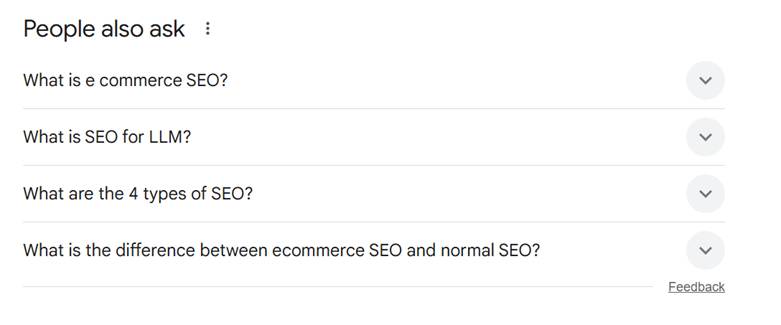
- You might turn to the same AI platforms you are optimizing for – ask Gemini or ChatGPT to generate real question queries that users might input into LLMs
- Use People also ask section in search results
Once you prepare a list of queries that people might ask an LLM it is time to see how your brand shows up relative to competitors. In order to put together your optimization strategy you need to answer a few questions:
- Track who is being cited or mentioned for each query
- Identify which queries your competitors appear and you don’t
- Find out which of your own queries you appear for and which specific assets are being cited – pinpoint what’s working
Knowing above, you can get key insights:
- Thematic visibility gaps – identify where your brand underperforms in LLM responses, so you can get a clear picture of areas needing attention.
- Third-party resource mapping – find out which external resources LLMs reference most frequently, so you can build a list of high-value third-party sites that contribute to visibility
- Blind spot identification – after cross referencing with SEO performance you can highlight blind spots – topics where your brand’s credibility and representation could improve
Once you know it you can put together a strategy to fill in content gaps and answer questions users are asking on LLMs.
Don’t forget about SEO best practices
AI isn’t replacing SEO. LLMs are trained on public data, so you need a solid SEO strategy to maximize the amount of data coming from your webstore.
Only in-depth and comprehensive content signals to LLMs that your website is an authoritative source worth citing when users ask detailed questions.
Make sure to follow all the standard SEO best practices, which include:
- Comprehensive keyword research and natural inclusion in content
- Solid internal linking strategy – so search engines and LLMs can pull relevant content without obstacles
- Strong backlink profile to signal authority
Find out even more information included in our Ecommerce SEO: The Complete Guide article.
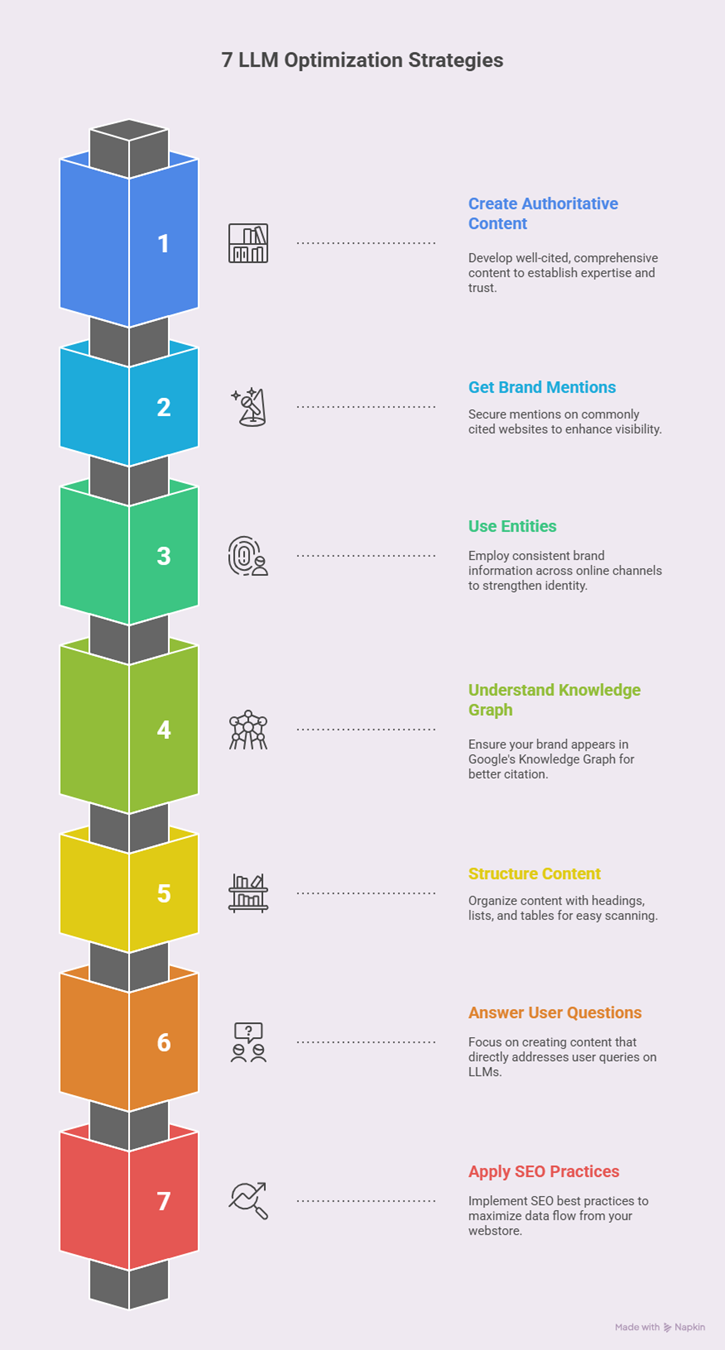
How to do LLM optimization?
6 practical strategies that you can implement to optimize your webstore for LLMs include:
- Create authoritative content
- Get brand mentions on commonly cited websites
- Use entities
- Understand the Google Knowledge Graph
- Make use of structured and semantic content
- Answer questions users are asking on LLMs
Large language model (LLM) optimization is a practice of optimizing your content, webstore and brand presence to appear in AI-generated responses. It can not work itself without a strong and solid SEO strategy.
Remember that the AI and LLM landscape is emerging and evolving quickly. The more you start following best practices now, the better you can position your business in near future and stay on top of you search visibility to power organic growth.
How to track and measure LLM visibility?
As always you can not manage and make decisions on something you can not track. That is why it is important to implement measuring strategy to your LLM optimization, so your future decisions are informed and backed with data.
It is worth to understand core challenges when tracking LLM visibility:
- LLMs do not publish query frequency or ‘search volume’ equivalents which you might be familiar in case you’ve been using Google Ads
- AI responses vary subtly (or more) even for identical queries, due to probabilistic decoding and prompt context
- Responses depend on hidden contextual features – like user history, session state, embeddings – that are opaque to external observers
While traditional search behavior is repetitive, LLM interactions are conversational and variable. Below I described the best current approach to track LLM visibility.
4 ways to track and measure LLM visibility include
1. Referral tracking in Google Analytics 4:
You need to use Exploration and create new report based on regex formula which includes all LLMs you would like to track. Here you can find detailed instruction on how to do it.
2. Share of voice (SOV) tracking:
Prepare a list of high-value queries for your brand and measure how often your brand appears as mentions and citations across them. Consistent set of high-value queries provides a benchmark to track over time and compare against competitors.
3. Branded homepage traffic in Google Search Console:
Customer journey for a person using AI tools looks different, it starts with observable AI mention – brand research – direct visit later. Brands are discovered through LLM responses and later searched directly in Google to validate or learn more. When you can observe increasing branded homepage traffic alongside with rising LLM presence it signals connection between LLM visibility and user behavior. That way you can capture the downstream impact of your LLM optimization efforts.
4. Software for monitoring brand mentions in LLMs:
For example Semrush Enterprise AIO that generates brand-specific prompts to cover entire buying journey, later prompts are used to measure your visibility and portrayal across LLMs. Semrush offers as well Semrush AI Visibility Toolkit if you don’t find enterprise tool right for you. One more to mention here is Brand24.
Remember that nobody has complete visibility into LLM impact on the business today, but 4 methods listed above cover all the bases you can currently measure.
Tracking LLM visibility is essential because it represents a critical, high-impact channel within modern SEO. As users increasingly rely on AI tools for summarized answers and recommendations, measuring this visibility confirms that your LLM Optimization (LLMO) efforts are working.
It ensures your brand remains part of the narrative by confirming accurate inclusion and tracking positive sentiment in AI-delivered responses. By monitoring citation authority and factual accuracy, you protect your reputation and validate that your highest-authority content is successfully influencing the AI’s ‘knowledge base.’ This visibility drives future growth by securing your brand’s position as an AI-trusted source.
Prepare for an AI future
LLM optimization isn’t just about gaining visibility now – think about it as an investment in the future. With more and more people using AI tools to search for products or brands you can’t stay behind and leave what’s on the table to others. The raise of agentic commerce might reshape retail world with AI agents acting on behalf of both customers and businesses. You can prepare your business and brand for the future with proper LLM optimization strategy.
Key takeaways:
- LLM optimization is the process of optimizing your content, webstore and brand presence to appear in AI-generated responses from tools like ChatGPT, Gemini, Perplexity, Claude, Google’s AI Overviews and Google’s AI Mode. The goal is to leverage LLMs as the new source of traffic to expand beyond traditional search engines.
- Proper LLM optimization strategy includes: creating authoritative content, getting brand mentions from commonly cited websites, entity optimization, boosting your presence in Google Knowledge Graph, optimizing your content (structured and semantic content is a key), answering the questions users are asking on LLMs, sticking to SEO best practices
- Track and measure LLM visibility, so you can make informed decisions backed with data, nobody has complete visibility into LLM impact on the business but with referral tracking in Google Analytics 4, share of voice (SOV) tracking, branded homepage traffic in Google Search Console and software for monitoring brand mentions in LLMs you can cover all the bases that can be measured
FAQs:
What is LLM optimization (LLMO)?
LLMO stands for Large Language Model Optimization. LLM Optimization is the process of optimizing you content, brand and webstore presence to appear in AI-generated answers like ChatGPT, Gemini, Perplexity, Claude, Google’s AI Overviews and Google’s AI Mode.
How do I get my webstore into LLM responses?
Prepare LLM optimization strategy that includes: authoritative content, brand mentions from commonly cited websites, entity optimization, presence in Google Knowledge Graph, optimized – structured and semantic content, answers to questions users ask LLMs, SEO best practices.
What tools track AI visibility?
You can use Google Analytics 4 to measure referral traffic from LLM-powered search engines like ChatGPT or Perplexity, branded homepage traffic in Google Search Console and software for monitoring brand mentions including Semrush AI Visibility Toolkit, Semrush Enterprise AIO or Brand24.
Do backlinks still matter for LLM Optimization?
Yes, high-authority backlinks from credible, widely cited sources increase your chances of being trusted and surfaced in AI answers.
Can small business benefit from LLM Optimization?
Yes, optimizing early is your advantage. If your competitors aren’t optimizing yet, you can claim visibility before them. Mastering LLM Optimization helps local businesses appear in AI-driven recommendations for specific products or locations.
Get the latest ecommerce tips and news
- The Real Cost of Running an Outdated POS System

- Why Best Sellers Carousels Are One of the Easiest Ways to Boost Conversions

- What B2B Buyers Expect in 2026 (And Why Your ERP Matters More Than Ever)
