B2B ecommerce has changed dramatically over the past few years. What once relied on phone calls, emailed purchase orders, and manual pricing spreadsheets is now expected to work just as smoothly as a modern consumer shopping experience.
But with one major difference: B2B buying is powered by business rules, not just shopping carts.
Pricing agreements, account structures, credit terms, product availability, and order workflows already live inside your ERP. For many businesses using Microsoft Dynamics 365 Business Central, that system already contains the logic that governs how customers buy from you.
The challenge is ensuring your webstore reflects that logic automatically. Modern B2B buyers expect an online experience that mirrors the way they already do business with you.
The Modern B2B Buying Experience
In 2026, B2B buyers expect much more than a basic online catalog. They want the same level of convenience they experience when purchasing consumer products online.
But they also expect the platform to understand their relationship with your business. Some of the most common expectations include:
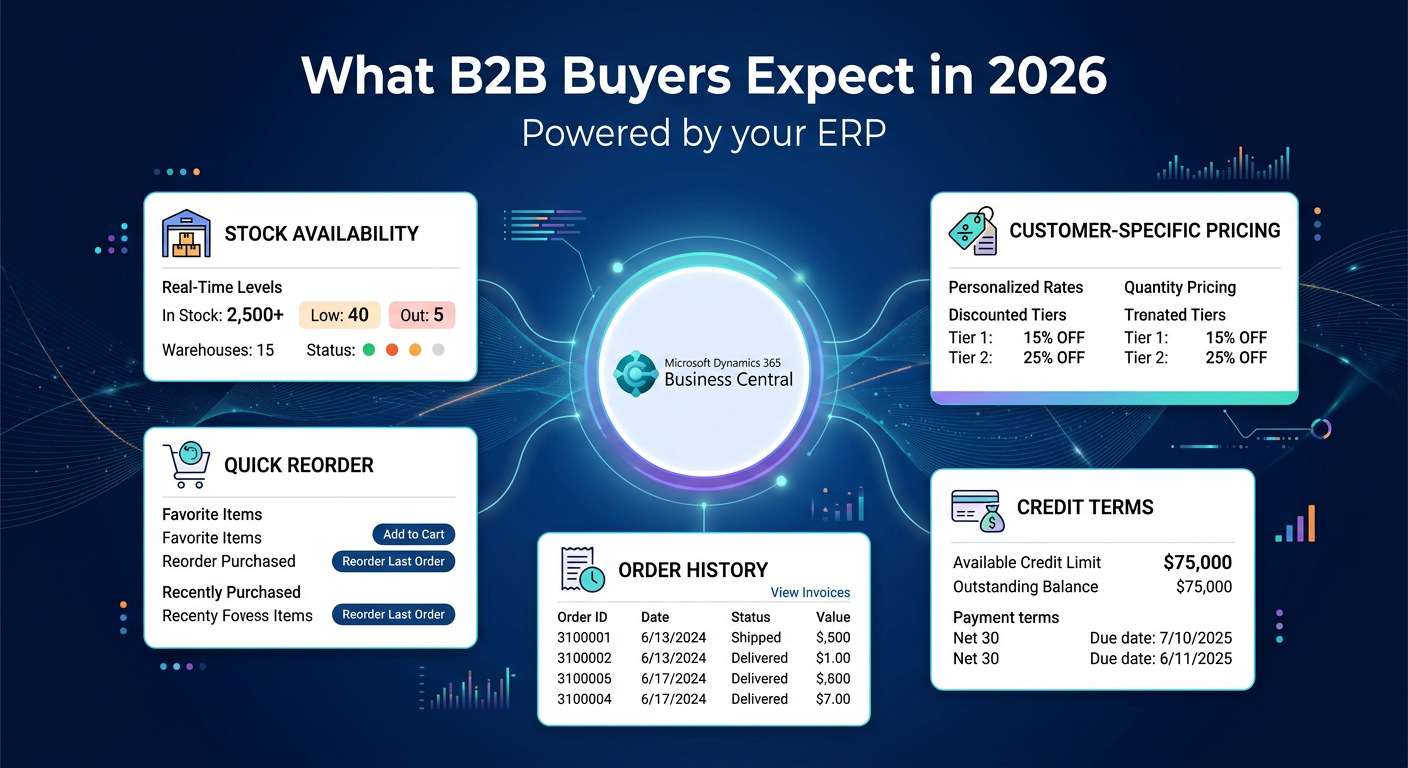
1. Customer-Specific Pricing
B2B pricing is rarely universal. Distributors, resellers, and contract customers often have negotiated pricing, volume discounts, or special terms.
Buyers expect that when they log in to your portal, they immediately see their price, not a generic list price.
When pricing is already maintained in Business Central, the webstore should simply display it rather than recreate it.
2. Account-Based Catalogs
Not every customer should see the same product range.
Manufacturers and wholesalers often restrict certain products to specific distributors or regions. Buyers expect a portal that shows only the products relevant to their account.
This simplifies purchasing and reduces confusion.
3. Order History Visibility
B2B customers frequently reorder products they have purchased before.
Access to full order history allows buyers to quickly review past purchases, check order status, or download documentation. It also reduces the number of customer service requests for order confirmations and invoices.
4. Quick Reordering
Efficiency matters in B2B purchasing.
Buyers placing recurring orders expect features like:
- Quick reorder from previous orders
- Saved product lists
- Fast SKU search
- Bulk ordering
These tools dramatically reduce the time required to place repeat orders.
5. Credit Account Checkout
Unlike most B2C transactions, many B2B buyers operate on credit terms.
A modern B2B portal should support workflows like:
- Purchase orders (POs)
- Credit account checkout
- Net payment terms
- Invoice-based payment
These purchasing methods are already managed in your ERP and should be reflected online.
Why ERP Integration Is the Foundation of B2B Commerce
Many ecommerce platforms try to recreate these rules inside the website.
That approach quickly leads to problems.
Duplicate pricing logic, delayed inventory updates, and manual corrections become common when the webstore and ERP operate separately.
For companies running Microsoft Dynamics 365 Business Central, the better approach is to allow the ERP to remain the system of truth.
Your webstore should simply reflect what Business Central already knows.
When properly integrated, this means:
- Customer-specific pricing updates automatically
- Inventory levels are accurate in real time
- Orders are written directly back to Business Central
- Customer account data stays consistent
Instead of maintaining business logic in two places, everything remains centralized.
The Role of Self-Service in B2B Growth
One of the biggest drivers behind B2B ecommerce adoption is self-service purchasing.
Modern buyers want the ability to place orders at any time without needing to contact a sales representative.
A well-designed B2B portal enables customers to:
- Check stock availability instantly
- Place orders 24/7
- Access invoices and documents
- Reorder frequently purchased products
- Manage their accounts independently
For suppliers, this reduces operational overhead while improving the buying experience.
Sales teams can then focus on strategic accounts and complex deals rather than processing routine orders.
Scaling B2B Commerce Across Markets
For manufacturers and distributors expanding internationally, digital commerce also becomes essential.
A B2B platform must support features like:
- Multi-language storefronts
- Multi-currency transactions
- Region-specific catalogs
- Local tax and shipping rules
When these capabilities are connected to your ERP system, businesses can scale their operations across markets without introducing operational complexity.
B2B Ecommerce Should Mirror Your ERP, Not Replace It
The most successful B2B ecommerce implementations don’t try to replace ERP logic.
They extend it.
Your ERP already manages:
- Pricing rules
- customer relationships
- inventory
- credit terms
- order processing
Your webstore should simply make that data accessible to buyers in a modern, easy-to-use interface.
When B2B commerce mirrors ERP rules instead of recreating them, companies gain:
- fewer manual corrections
- more accurate pricing and stock
- faster order processing
- better customer experiences
👉 Learn more about WebSell’s Dynamics 365 Business Central integration.
WebSell and Dynamics 365 Business Central
WebSell is built to integrate directly with Microsoft Dynamics 365 Business Central, allowing businesses to deliver modern B2B ecommerce experiences while keeping Business Central as the system of truth.
With real-time synchronization of products, pricing, customers, and orders, WebSell enables distributors and manufacturers to provide the digital purchasing experience modern buyers expect.
If you’re already managing complex B2B workflows in Business Central, your webstore should simply reflect them.
Not recreate them.
Get the latest ecommerce tips and news
- The Real Cost of Running an Outdated POS System

- Why Best Sellers Carousels Are One of the Easiest Ways to Boost Conversions

- What B2B Buyers Expect in 2026 (And Why Your ERP Matters More Than Ever)
